Hardscaping • Pools • Decks • Landscaping • Snow & Ice
Langhorne has the heaviest concentration of regional commercial traffic in Lower Bucks, and in a snow event that changes what a contract has to cover.
A strip center with forty customers an hour and a medical building where an ambulance needs the bay clear at 3am are not the same job, even if they’re a mile apart and the storm is identical. Route priority isn’t a scheduling detail here — it’s the entire contract.
C&J Outdoor Services provides commercial snow removal, plowing, salting, and ice management for retail, medical, office, hospitality, and HOA properties throughout Langhorne, Pennsylvania.
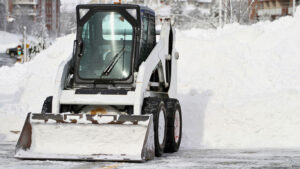
Snow plowing — parking lots, drive aisles, loading docks, and access roads cleared to the trigger depth in your contract
Salting and de-icing — pre-treatment ahead of a forecasted storm, plus application during and after
Sidewalk and entrance clearing — hand crews for building entrances, ADA ramps, crosswalks, and pedestrian paths
Ice management — refreeze monitoring and black ice treatment through the freeze-thaw cycle that follows most Bucks County storms
Snow relocation and stacking — moving piles off parking spaces and out of sightlines as accumulation builds
Snow hauling — off-site removal when piles outgrow the storage room on your lot
24/7 storm response — The phone is always on, just give us a call
The Oxford Valley and Route 1 corridor is regional-draw retail — enclosed mall, big-box centers, and strip plazas drawing from three counties. Large lots, high vehicle turnover, and long pedestrian runs between parking and entrances.
Snow storage is the constant problem. Every event pushed to the perimeter takes parking spaces out of service, and by the third storm of a bad winter there’s nowhere left to put it. On these properties relocation and hauling aren’t contingencies, they’re a line item you plan for in October.
The clearing windows are also tighter than they look. Several of the larger centers along this corridor open at 6am and don’t close until 10pm, which leaves about seven hours to clear a lot that takes most of that even in good conditions. There’s no margin for a truck that shows up late.
Medical properties are the most demanding work in this market and the least forgiving. Ambulance access, patient drop-off, and staff parking are functionally zero-tolerance surfaces — they don’t get cleared at the trigger depth in your contract, they get pre-treated before the storm and maintained continuously through it. A patient walking from a car to a door on an untreated surface is a different category of risk than a shopper doing the same thing, and the contract has to reflect that.
Hotels and hospitality near the Route 1 and Oxford Valley interchange cluster tightly — several full-service and select-service properties within a mile of each other, driven by the theme park and the medical campus. They run continuous arrival and departure, so there’s no overnight window where a lot sits empty. Work happens in passes around occupied spaces, entrances stay open the entire time rather than being closed off while a truck works, and guest vehicles have to be cleared around rather than plowed in.
Langhorne Borough’s small commercial district is the opposite scale — tight frontage, on-street parking, narrow sidewalks, and effectively nowhere to stack. Clearing there is a question of where the snow goes as much as how fast it moves.
Two municipalities also matter here: Langhorne Borough and Middletown Township have separate ordinances on snow placement relative to the public right-of-way and separate municipal plow priorities. We confirm which one governs your property during the site walk and write the scope around it.
Most property managers want four things confirmed before signing.
Insurance and certificates. We carry general liability coverage and can issue a certificate of insurance naming your property as additional insured, usually same-day.
Response time. Crews are dispatched once accumulation reaches the trigger depth in your contract — typically 2-4 inches. Medical and other zero-tolerance properties are pre-treated ahead of the storm and maintained continuously rather than waiting on a trigger.
Route priority. On a corridor this busy, the order properties get cleared matters as much as how fast. Priority is set in the contract before the season starts, not decided on the morning of a storm.
Contract structure. We write both seasonal and per-event agreements. A seasonal contract fixes your winter cost regardless of snowfall, which protects you in a heavy year and makes budgeting predictable. Per-event billing charges by storm and accumulation, which suits properties that would rather pay only for what falls. Either way you get a defined trigger depth, a documented scope of what gets cleared, and a service log for every visit — which matters if a slip-and-fall claim is ever filed.
Yes. Medical properties need pre-treatment before the storm and continuous maintenance through it rather than clearing at a trigger depth — ambulance bays, patient drop-off, and entrances are treated as zero-tolerance surfaces. That scope is written differently from a standard retail contract.
On the large Oxford Valley-area lots this comes up by mid-season most winters. We plan stacking areas during the pre-season site walk and build relocation and hauling into the contract so it's a known cost rather than an emergency call after the third storm.
Pricing depends on lot size, sidewalk footage, trigger depth, and whether you choose seasonal or per-event billing. We give you a fixed written quote after walking the property — no per-storm surprises.
Langhorne Borough and Middletown Township are separate municipalities with separate ordinances on where snow can be placed relative to the public right-of-way, and separate plow priorities. We confirm which governs your property during the site walk and write the scope around it.
Snow removal generally means plowing and clearing accumulation. Snow and ice management is the full program — pre-treatment before the storm, plowing during, salting after, and monitoring for refreeze in the days that follow. Most commercial properties need the second, because liability comes from ice at least as often as from snow.
Both. Sidewalks, entrances, and ADA ramps are where most slip-and-fall claims originate, so we treat pedestrian surfaces as core scope rather than an upsell.
August through October. Routes fill on a first-come basis, and properties that wait for the first forecast often find local contractors are already committed.
We also serve nearby Bucks County, PA communities including Levittown, Fairless Hills, Middletown Township, Newtown, Yardley, Bristol, Morrisville, Tullytown